


What’s in it - and what’s next?
As one of the final acts before dissolving the 18th Legislative Assembly, Northwest Territories’ Commissioner Margaret Thom gave her royal assent to the territory’s first-ever stand-alone Mineral Resources Act.
Championed by then Minister Wally Schumann, the formal passage of the Mineral Resources Act, culminated almost four years of development by the GNWT’s Department of Industry, Tourism and Investment.
Listening, Balancing, Compromise
That work included timely and detailed engagements with industry and Indigenous governments alike.
“The result,” says Pamela Strand, Assistant Deputy Minister, Minerals and Petroleum Resources, “is legislation that will lay the groundwork for a stronger mining and exploration sector – and one that reflects the realities of doing business in the NWT.”
So what’s in it for Industry? Understandably, when governments make new laws about mining and exploration, companies get wary. “We understand that,” Strand says. “Our message is that there’s a need for balance – and to recognize our modern way of operating in the NWT.”
The focus on balance appears to have paid dividends. Industry, Indigenous governments and other stakeholders have all publicly expressed their support for most of the new Act - no small feat in a process where differences can sometimes become the norm.
“Our focus on a solid and inclusive engagement process means we’re starting with a solid foundation,” Strand says. “As we move forward and as industry stakeholders and Indigenous governments find common interests reflected in legislation, I think it’s safe to say we’re going to be successful in working together.”

Pamela Strand, Assistant Deputy Minister, Minerals and Petroleum Resources
Through the development process, industry’s primary advocacy group has been the NWT and Nunavut Chamber of Mines. “Their input contributed significantly to the design of an Act that would allow us to stay competitive in the global industry.“
Already, the legislation is receiving acclaim for its unique approach to legislating benefits. While the territory has become the first in Canada to legislate the requirement for some kind of benefit agreement, it has left the content of the agreements up to the regulations.
“It’s consistent with the growing move towards sustainable finance,” says Strand. “We know investors want to see benefits for Indigenous peoples demonstrated in resource projects. The flexibility in this approach allows Indigenous governments and mining companies to decide what will work for everyone.”
Incentivizing Exploration
In remote areas, like the Northwest Territories, it can be tough to get your boots on the ground as an early explorer.
The Mineral Resources Act sets the stage for new incentives to encourage exploration. The mechanism for doing so is through designated “zones”.
The establishment of such zones would allow for improved terms and conditions for explorers willing to invest in priority or difficult-to-explore areas.
It’s a common concept in mining legislation, but comes with a novel twist in the NWT. Here, Indigenous governments will also have the opportunity to propose these incentive zones. Zones are not meant to be permanent and will be reassessed regularly. Envisioned incentives could involve work requirements and fees but would not extend to the royalty regime.
“The result is an incentive structure we believe will give explorers a better idea of where Indigenous governments want to see exploration,” Strand says. “We see it as a valuable relationship-building tool.”
Collecting Valuable Geoscience; Protecting Commercial Information
Mining is an industry built on intellectual property, of which the most valuable currency is the geoscience which allows explorers to target their efforts.
The NWT’s legislation creates new ways for the government to collect geoscience information across the mining cycle through three key methods: work reporting for mineral claims, statistical returns from producers and explorers, and by enabling the government to collect abandoned drill core and make it available publicly.
“The hope is that this adds data to our geological database,” Strand says.
But the currency goes two ways. Miners and explorers have an interest in protecting their data while working on their properties.
“We respect that,” Strand says. “That’s why our regulations also have reasonable confidentiality measures to protect that commercial information.”
Building Better Relationships
The Northwest Territories is a unique jurisdiction where management of land and resources is shared between public and Indigenous governments.
That means there will always be more variables at play for miners and explorers.
The Mining Regulations — passed down by the federal government when the NWT took the reins of land and resource management in 2014 — did not reflect this reality. It was a common and recurring concern for all stakeholders: governments, communities and companies.
Today’s NWT legislation changes that and sets the stage for: work credits for Indigenous engagement activities, predictable dispute resolution processes, and notices to Indigenous governments about claim staking.
Indigenous engagement work credits will mean explorers and companies will be able to count their engagements with Indigenous governments towards their work requirements. “It comes down to two key concepts: engaging with Indigenous peoples is something we want to see and, as a government, we need to recognize that cost and time commitment,” Strand explains.
For industry working in the NWT, the practice of engaging Indigenous government is not new and already defines the way business is done in the territory.
“Companies will be able to get credit for what they have helped to make an industry standard in the NWT,” Strand says. “The benefit is threefold. Companies will be able to prioritize engagement spending when it makes economic sense. When it comes to mineral tenure maintenance, the value of relationship-building will be recognized and thereby encouraged. And ultimately, the goal is that conflicts between explorers and Indigenous governments are reduced.”
As far as dispute resolution goes, the legislation sets the stage for several new mechanisms to arbitrate specific disputes between companies and governments.
First, it empowers the Minister to strike an independent panel to make decisions to resolve disputes on the negotiation of benefit agreements between Indigenous governments and industry. The board would include experts from a variety of fields, including the mining industry, to make a decision based on the information provided.
Second, it establishes a Mineral Rights Advisory Panel to independently arbitrate specific disputes under the Act. Like the panel expected to arbitrate benefit agreement disputes, industry experts will have a seat at the table alongside other experts.
Lastly, the new laws put the burden on government to provide notice to Indigenous governments when mineral claims are applied for in their traditional territory. “We’re taking the lead on getting these relationships off on the right foot,” Strand says.
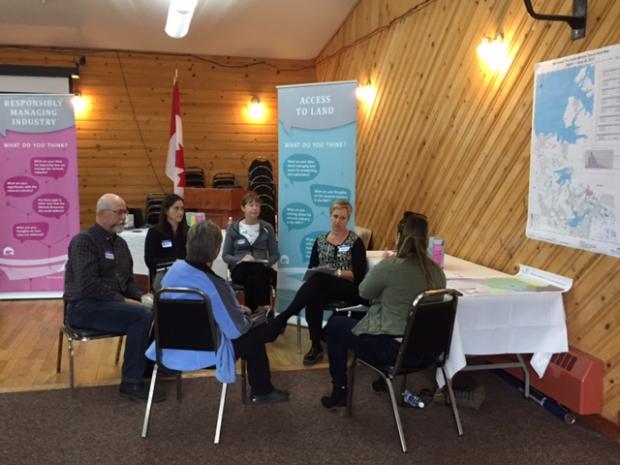
Community engagement session for Mineral Resources Act
Bringing Administration and Staking Into the 21st Century
The new laws set the stage for the online administration of mineral rights and that, once the technology and rules are developed, will enable online map staking.
“This is something industry has been requesting for a long time, but we were never in a position to do,” explains Strand. “Now, we can get to work on building the technology that will allow us to provide transparent, responsive and modern staking and administration of NWT claims.
What’s Next?
With the passage of legislation complete, the work to create regulations begins.
“We’ll be bringing the provisions of the Act into force in phases,” Strand says. “We hope to have the key regulations complete over the next two to three years.”
But, implementing new technology for administration and staking will take longer. “This kind of rule-making and technology development doesn’t happen overnight. Ontario took close to 10 years to complete its transition to an online system. We will need to work on a client-by-client basis to make sure we get the digitization of existing interests done right.”
As there has been all along, Strand says there will be roles for both industry and Indigenous governments to play in developing the new rules and technology.
“One of the goals in initiating this work was to increase investor certainty when it comes to the NWT mining sector. This Act can do that. But as much as we have - and will continue to – develop this Act together, we will also need to work in concert to endorse these new laws to our investors and stakeholders.
The most important thing that we can do now is to get behind this Act – together - and to make it work like we designed it to; for the good of everybody in the NWT.”