
November 21, 2018
South Slave residents were the first to enjoy screenings last week of the much-anticipated film Three Feathers.
Based on the graphic novel by Richard Van Camp, and illustrated by Neiva (Krystal) Mateus, Three Feathers is a story of restorative justice for three young men in a small community.
Van Camp recalls meeting Mateus years before they collaborated on the project. “She was known around town for carrying this book bag loaded with sketchbooks which were filled with manga and hyper-realistic drawings. My jaw dropped when I saw how talented she was. I told her that someday I was going to get in touch with her to work on a project.”
“I don’t think she believed me at the time,” he laughs.

Three Feathers originated from the urging of Brent Kaulback of the South Slave Divisional Education Council. He asked Van Camp to set out to write a story in which language and culture helped youth get out of trouble.
“The beauty of fiction is that you can mend what has been broken...” Van Camp notes, quoting the teaching of his mentor, Lee Maracle.
Van Camp’s novel was published in 2015 by Highwater Press (Portage & Main Press); appropriately in Cree, Chipewyan, English and South Slavey. Once again, it was Brent Kaulback who suggested the next step: “We should turn this story into a movie.”
“We were so lucky to have Carla Ulrich, our director, living in town, working on numerous projects for our community,” Van Camp says. “It was destiny that Carla would be our director and visionary for the project!”
 Credit: Sarah Pruys/South Slave Divisional Education Council
Producers Liz Levine and Brent Kaulback along with Director Carla Ulrich went to work using the graphic novel as a storyboard. The project would require significant support from the NWT Film Rebate Program, the Indigenous Languages and Education Secretariat, the SSDEC, Associate Producer Ann Lepine, Salt River First Nation, Smith’s Landing First Nation and the Northwest Territories Métis Nation.
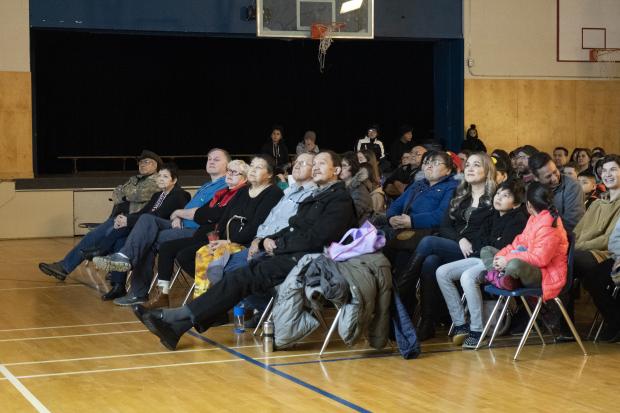
After three years of fundraising and filming, the English version of Three Feathers had its community releases last week in Fort Smith, Fort Resolution, Hay River and Łutselk’e.
The Cree, Chipewyan and South Slavey versions are in post-production.
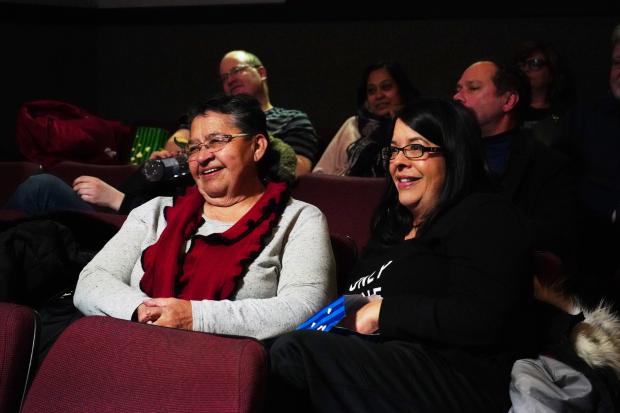
On Friday evening Van Camp got to see the final cut of his film on screen for the first time. He described it as “beautiful.”
Van Camp wasn’t the only viewer to fall in love with the film. “It makes me so proud. This is a movie we can show anyone in the world and they will feel the heart of it and, hopefully, come up to Fort Smith, NWT, our town, and explore the majesty of our community and the land that teaches us so much about life, resilience and sharing.”
Click on the link below to see the trailer:
“Many people commented on the beauty of the film. The scenes are like paintings - Craig Kovatch did a terrific job with cinematography. It certainly creates a compelling reason for visiting the NWT and specifically the Fort Smith region” Van Camp said.
Three Feathers is believed to be the first movie ever been shot in four different languages simultaneously. The family-friendly film is a community success story. Northern creators flexed their muscles not only in-front of the camera but in all aspects of its production. Five rounds of shooting, over the course of a year, were required to capture the necessary weather and light for the film.
 Credit: Sarah Pruys/South Slave Divisional Education Council
Van Camp’s next goal is to get the film into the festival circuit and have it promoted internationally.
“It can be viewed as an educational piece and a commentary on the possibilities of restorative justice in a northern setting,” he hopes.
For more information on NWT Film and how you can access funding click here.