


February 21, 2020
(Photos courtesy of Weaver & Devore)
Ken Weaver remembers a time when he and his seven siblings would come home after school and get to work at his parent’s store. They would bag groceries, stock shelves, clean coolers and generally tidy the store. In the evenings his youngest sister could be found curled up with a blanket in a cozy corner of the store.
When Yellowknife’s first general store opened its doors in 1936, its owners Harry Weaver and Ellis “Bud” Devore, had no way of knowing that it would sustain four generation of family.
“Basically, if your name is Weaver and you want to work, you’ve got a job here,” Ken Weaver says with a chuckle.
Related Stories:
As the city grew, the store adapted and found niches of clients from one decade to the next. In its early days, they catered to local hunters and trappers, buying and trading furs. In the 50s and 60s, with the booming Great Slave Lake fishery, their clientele included the fishermen and women pulling pickerel and whitefish from the lake. With the growth of mining and exploration camps, the store had yet another industry to cater to.
In fact, Weaver & Devore is such an intrinsic part of Yellowknife’s culture and history that there is even a word for it in the Tłı̨chǫ Yatıı̀ dictionary. The owners have been told the translation has been broken down into parts and roughly translates to ‘Short raggedy Harry’s store’ but they haven’t had that confirmed.
“We’ve evolved quite a lot over the years but we’ve always managed to carry a very stable inventory,” Weaver says. “We’ve never been a fashionable store. We’re very practical and we cater to local people.” As one Facebook fan puts it, “there is nothing you need to live you can’t find at Weaver and Devore”.
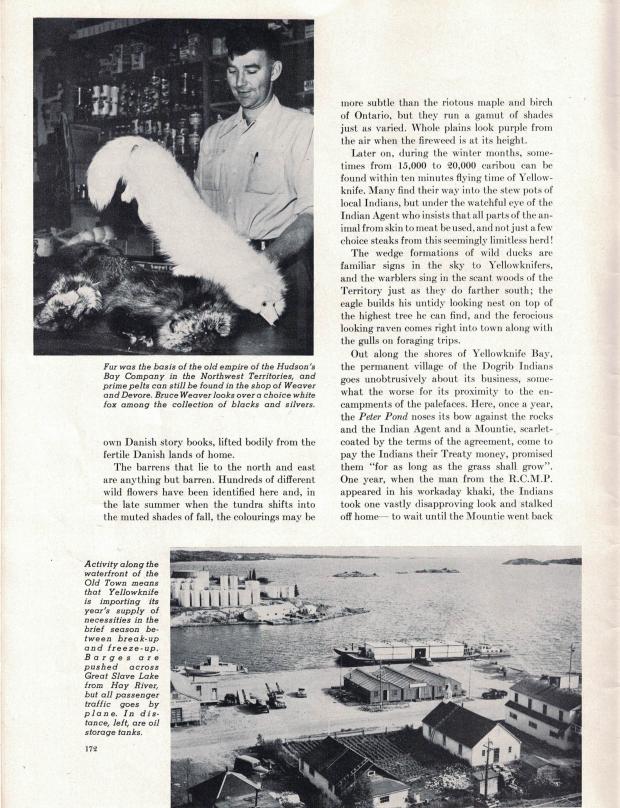
(Photo: Bruce Weaver examines pelts in an article published by Canadian Geographical Journal, May 1954).
Something the store’s forefathers may not have anticipated in the shop’s multi-generational history: tourist busses and vans lining their parking lot.
Weaver & Devore has become a tourist hot-spot, with several guides including the shop in their city tours and many of them stopping so tourists can flock inside and do some shopping. The most popular item? Parkas.
While most locals bemoan the frigid winter temperatures, -40C is actually great for business at Weaver & Devore, which carries a robust stock of light, medium and heavy-weight parkas. Ranging from $600-$1,200 per parka, the influx of tourists to their store can have an impact.
“The visitors we get in here are very outgoing and hearty,” Weaver says. “They come up here not knowing what -40C will be like but it doesn’t slow them down at all, once they’re dressed for it.”
Eighty-three years has passed since the Weaver & Devore front door first swung open.
“There is definitely a sense of pride in carrying the name forward,” Weaver says. “We would love to have our forefathers see it; the growth, how busy it is compared to how things were when they first started. In the early days they would have been lucky to take in $100 a day. We have definitely grown as the population in the north has grown and the visitors increase.”
From the early days of trading and trying to make ends meet, to today when Weaver’s great granddaughter has brought the company onto Facebook and tourists line the aisles, much has changed but one thing is certain: the store’s success has meant that four generations have been able to raise families and build their lives in the north.
-----------------------------------------------------------------------------------------------------
We know that the tourism industry creates jobs and a healthier economy, but what about the not-so-obvious benefits? #ValueOfTourismNWT is a blog series highlighting the ways the tourism industry contributes to our communities that can often be overlooked.
From tourism facilities and services that locals can also enjoy, to cultural preservation and community wellness, there are countless ways the territory’s growing tourism industry benefits locals. Follow the blog series to learn more.