
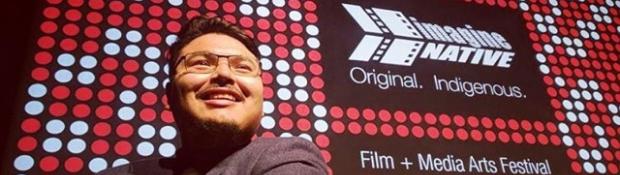

January 13, 2019
Mason Mantla’s rise in the film industry has been nothing short of meteoric over the last few years. After his film Fireweed premiered at Yellowknife’s Dead North film festival two years ago and took home the NWT Film Commission’s Best Location Award, it went on to screen at the Reykjavik Film Festival and ImagineNATIVE. Since then, he’s been a regular on the film festival circuit – walking the red carpets nationally and internationally.
Now, he’s been awarded Bell Media’s Harold Greenberg funding for his latest project Nahga, who knows what’s on the horizon for the talented film producer.
We sat down with him for a Q&A about his growing success and how the north has influenced his work.
How does it feel to be the NWT’s recipient of the Harold Greenberg Fund and what does it mean for your film Nahga?
I feel honoured to be the recipient. It’s pretty crazy. For the longest time I’ve done short films with no budget so this is a big step up for me in terms of increasing my skill set, building a production team and expanding my scope. It means that I’ll be able to tell my story more freely. I won’t have to scale back from my vision.
Can you tell me a bit about your film Nahga?
I first got the idea for Nahga from my friend, Alicia Camille. After we screened Fireweed at Dead North two years ago we sat around telling scary stories and she told this story about Nagha. With permission, I wrote the screen play.
Nagha is a boogieman type creature from Dene legend. The story takes place in the 1980s and is about a Dene babysitter who is watching her brother and sister. She hears a knock at her door, opens it and there’s a little old lady. She’s an elder so the babysitter lets her in, warms her up and gets her tea. As they talk she begins to realize that this isn’t any old lady. She gets creepier and creepier. Her voice changes. Hair appears out of her stockings. The babysitter realizes that she’s a shape shifting spirit and has to keep her brother and sister safe.
Where will you be filming?
I’ll be filming all over Behchokǫ̀. I haven’t done location scouting yet, but I’ll be looking at places along the highway, cabins on the highway, and old looking building in town that are suitable for the era we’re going for.
It’s important to me that this story came from the Tlicho community so I want to honour it by having it shot in the Tlicho region.
You’ve hit some major milestones in the last couple years. Now with the Harold Greenberg funding under your belt – what’s next?
Well, I’m currently writing a short for Dead North to do over winter. Because of Dead North I was able to go to ImagineNATIVE. For years I had been wanting to go and two years ago I finally had a project [Fireweed] that was worthy of going. I’ve also been to festivals in North Dakota, Reykjavik, Dawson City, Whitehorse, Edmonton, and Toronto. I feel like this is just the beginning of my film career and I’m coming into my own.
Next, I want to start working on my feature film – whatever that may be.
What was it that made you want to get involved in the film industry?
I’ve always been interested in photography and videography. My high school offered a few of us jobs after graduation as part of the resiliency project to work with youth to see if they responded to media and art. After school we would do media clubs, music, film, and photography. The Health Authority expanded our team regionally to use film and media to communicate on difficult subjects. We create a short film with youth called Breaking the Silence, about suicide and sexual assault. The kids helped shoot and produce it and the film ended up premiering in Norway. All these kids were so excited to have this international premiere – that was kind of the start.
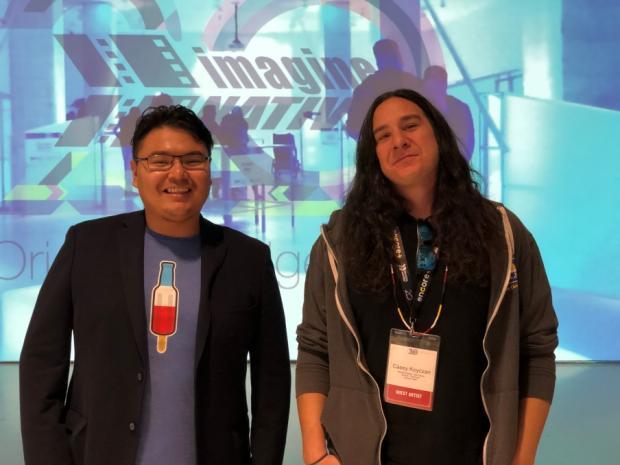
(Pictured: NWT artists Mason Mantla and Casey Koyczan at ImagineNATIVE 2019)
Where do you get your ideas for your films and what inspires you?
I pull a lot from my community. I grew up in a story telling environment. My grandparents took me out to the land, and they would tell us stories about giant animals and Yamozha. With that transfer of knowledge, that’s how my brain kind of formed. I always felt I was a writer at heart – I would write songs, short stories and pull from the people around me, from small town life and the north.
Are there any film locations in the NWT that you’re dying to film in?
I would really like to visit the Mackenzie Delta. I’ve never been that far north but I love the stark beauty that they have there. I watched The Sun at Midnight and some of it was shot there and it’s something you don’t see in other films; it’s unexplored in terms of cinema.
How have organizations like the NWT Film Commission helped?
Without the Film Commission I wouldn’t have been able to go to ImagineNATIVE to see my film screened. That was a pretty big moment for me to go to a film festival that I always wanted to go to. They’re working hard to bring a lot of notice to the NWT especially from down south, and that’s important. We can learn so much from professionals.